What Is Florence, Italy Best Known For?
A food-first answer to what Florence is best known for: the protected Tuscan products, the bistecca convention, Chianti Classico, the markets, and which tours actually serve each one.
What Is Florence, Italy Best Known For?
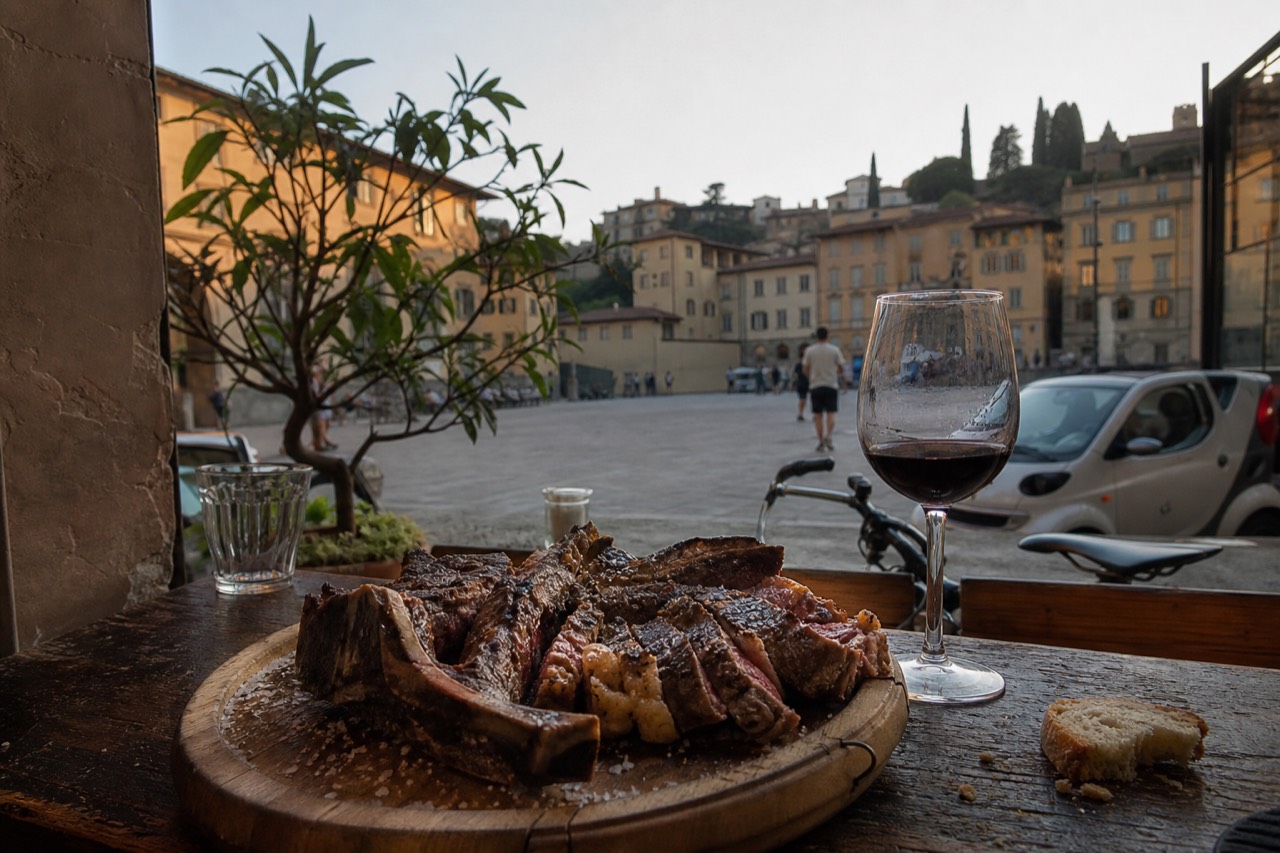
Florence is best known for Renaissance art and architecture, but on the plate it is known for a specific set of protected Tuscan products: Prosciutto Toscano DOP, Pecorino Toscano DOP, Finocchiona IGP, Cinta Senese DOP, Cantucci Toscani IGP and Pane Toscano DOP, plus Chianti Classico wine and a famous steak, the bistecca alla fiorentina, that has no protected status at all. The city is also the home of Mercato Centrale, the 1874 iron market hall whose upper floor became a food hall in 2014. That is the short answer. The longer one separates what is legally protected, what is convention, and what is simply famous, because Florence's food reputation mixes all three and most pages never tell you which is which.
The art answer is true and needs no correction: the Duomo, the Uffizi, the Accademia. But a food-first answer is more useful to a traveller deciding how to spend an evening, and Florence rewards it. According to La Nazione, reporting on the TasteAtlas 2025/2026 ranking, Florence placed fourth in the publisher's Best Food Cities in the World list, behind Naples, Milan and Bologna. A published ranking is a published ranking, not a measurement of food quality, but it does tell you the city's reputation now travels on its food as much as on its frescoes.
There is also a structural reason the food here is distinctive. Tuscany carries one of the densest clusters of EU-protected designations in Italy, and nearly all of them pass through Florence's markets, delis and trattorie. You can verify every one of them yourself in the European Commission's own geographical indications register, which is the only source that matters for what "protected" means. A full-text scan of all 4,014 entries in that register returns matches for prosciutto, pecorino, finocchiona and cantucci, and no match at all for bistecca, fiorentina, lampredotto, ribollita, schiacciata or trippa. Hold that thought for the steak section below.
This site, Florence Food Tours, exists to keep those three categories straight: the protected, the conventional and the merely famous. If you want to taste the famous things rather than read about them, these three tours cover the ground between them: the four-hour steak dinner tour, the cheaper sit-down steak-and-wine walk, and the street-food walk that fits a short visit.
Which Protected Foods Can You Actually Taste In Florence?
Yes, and in a single afternoon: Prosciutto Toscano DOP (protected since 1996), Pecorino Toscano DOP (1996), Lardo di Colonnata IGP (2004), Cinta Senese DOP (2012), Finocchiona IGP (2015), Cantucci Toscani IGP (2016) and Pane Toscano DOP (2016) are all sold in the city's markets and deli counters, and several of them appear by name in food tour itineraries. Each has a registering regulation in the Official Journal, a producer consortium behind it, and a defined production area. The saltless bread is the one that surprises visitors most: Pane Toscano DOP requires sourdough starter, water and specific soft-wheat flours from a defined Tuscan zone, which is why the bread tastes the way it does.
The table below is the honest version of a list most Florence pages compress into a paragraph. Where a dish has no protected status, the cell is blank on purpose, because the blank is the information.
| Dish or product | Status | Registered |
|---|---|---|
| Prosciutto Toscano | DOP | 1996 |
| Pecorino Toscano | DOP | 1996 |
| Lardo di Colonnata | IGP | 2004 |
| Cinta Senese | DOP | 2012 |
| Finocchiona | IGP | 2015 |
| Cantucci Toscani | IGP | 2016 |
| Pane Toscano | DOP | 2016 |
| Bistecca alla fiorentina | none | |
| Lampredotto | none | |
| Ribollita | none | |
| Schiacciata | none |
Notice what the blank rows have in common: they are the dishes Florence is most famous for among visitors, and none of them carries a DOP, IGP or STG. That does not make them lesser eating. It means nobody regulates the name, so quality depends entirely on the individual kitchen, stall or cart, which is exactly the kind of thing a good guided tasting helps you judge.
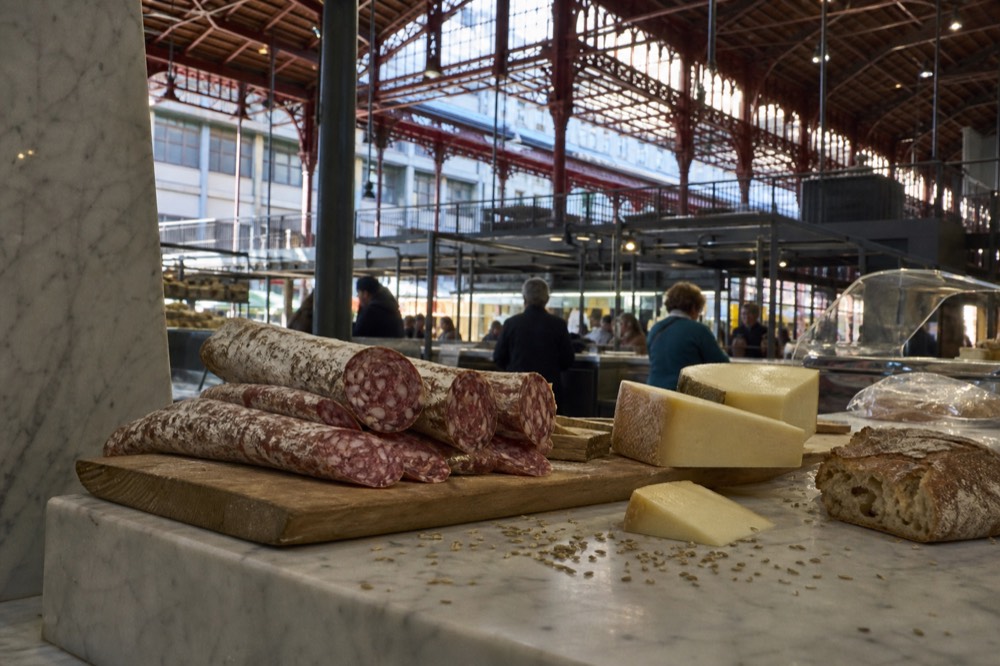
The protected products are easier. A wedge of Pecorino Toscano DOP is the same designation whether you buy it at Mercato Centrale or in a village shop in the Sienese hills, because the consortium and the specification guarantee the method and the area. Finocchiona IGP, the fennel-seeded salami, has been protected since 2015 and is a standard charcuterie stop on the central food walks. Cantucci Toscani IGP with Vin Santo is the classic ending, and one budget street-food tour, the Florence Old City Street Food Tour, names cantucci with Vin Santo among its six tastings. If you want the full picture of that end of the market, our guide to Florence street food tours breaks down every walk under $70.
If you would rather have someone walk you through the protected list with the tastings included, the classic tours in the middle price band do exactly that, and most of them can be cancelled free up to 24 hours before the start time if your plans shift.
What Is Bistecca Alla Fiorentina, Really?
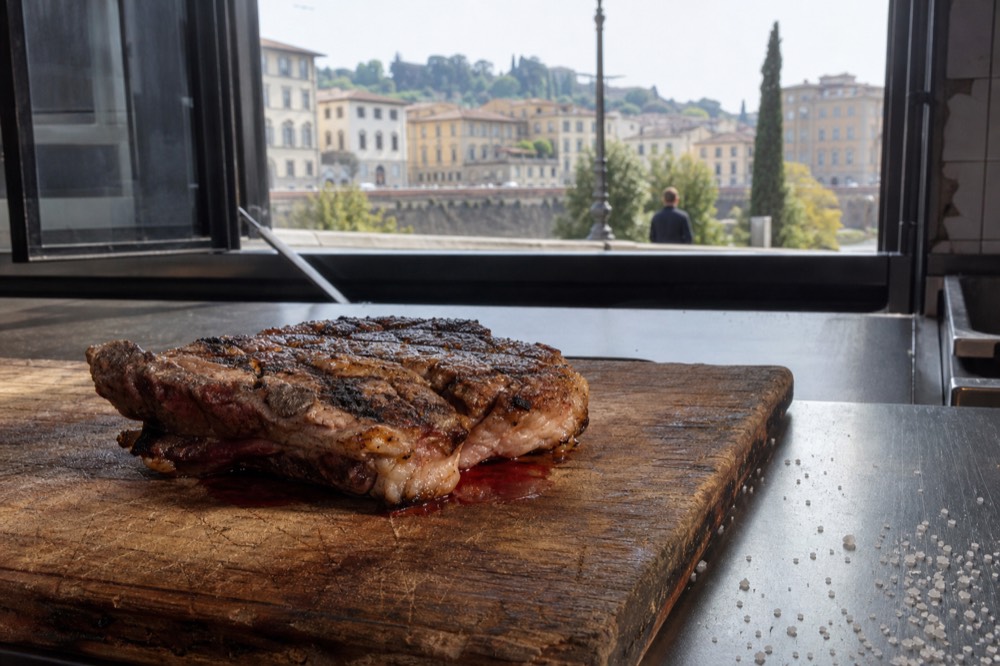
It is a thick-cut T-bone steak grilled over embers and served rare, and it is a convention, not a regulated product: there is no DOP, no IGP, no STG and no registered minimum thickness or weight for the cut, and no legal requirement that it come from Chianina cattle. The one real designation in the story is Vitellone Bianco dell'Appennino Centrale IGP, protected since 1998, which covers the meat of pure-bred Chianina, Marchigiana or Romagnola animals aged 12 to 24 months, and whose registered production area explicitly includes the province of Firenze alongside Grosseto, Siena, Arezzo, Prato, Livorno and Pisa.
This is the paragraph where most Florence food pages quietly invent rules. You will read that a real fiorentina must be "three to four fingers thick", or "at least 4 cm", or "minimum 1.2 kg", or that it must be cut from the lombata with the fillet on one side of the T-bone and the sirloin on the other. Those descriptions circulate widely. None of them has an operative document behind it: no consortium specification, no ministry decree, no municipal denomination. A scan of the entire EU register returns nothing for the name. The shape of the cut is convention, repeated until it sounded like law.
The same applies to the breed. Chianina is the celebrated white cattle of the Val di Chiana, and it is a fine marketing story, but the IGP that actually exists permits Chianina, Marchigiana and Romagnola equally. A steak from a Marchigiana animal can carry the Vitellone Bianco dell'Appennino Centrale IGP mark just as legitimately as a Chianina one. If a menu or a guide tells you Chianina is required for a real fiorentina, that is a claim no regulation supports.
What you can honestly say is this: the fiorentina is a T-bone by convention, usually grilled hard and fast and served blood-rare in the middle, priced by weight, and meant to be shared. It is also the single most expensive thing most visitors eat in Florence, which is why having it included in a tour matters. The Florence: Guided Food Tour with Fiorentina Steak and Wine runs four hours, includes truffle pasta, aged balsamic, the steak and wine, and carries a 5.0 across 349 reviews on the live listing; the listing also flags it as likely to sell out, so Check availability before you build your evening around it.
Where Does The Chianti Classico Story Fit?
Chianti Classico is the wine designation most entangled with Florence's identity: the Consorzio Vino Chianti Classico was founded on 14 May 1924 as Italy's first wine producers' consortium, the wine gained DOC status in 1967 and DOCG in 1984, and since 2006 every bottle must be at least 80% Sangiovese with only black grapes permitted in the blend. The Black Rooster emblem, taken from the historic Military League of Chianti, has been the symbol of the whole denomination since 2005 and must appear on every bottle, on the main, neck or back label.
The part almost nobody tells you is that Chianti Classico is also an olive oil. A separate PDO for Chianti Classico extra virgin olive oil was registered in 2000, with its own consortium. So when a guide in the hills south of Florence says "Chianti Classico", the phrase can legally refer to two completely different products, and a visitor standing in a frantoio in November is looking at the one that is not wine.
The consortium's own history pages are the primary source for all of the dates above, and they are worth trusting over the garbled versions that circulate on tourist menus. One detail worth carrying into a tasting: from 1996 the rules allowed 100% Sangiovese, which is why modern Chianti Classico tastes nothing like the thin stuff the region's reputation once suffered under.
For a Florence-based visitor, the practical point is simpler. Wine is included in nearly every classic food tour in the city, usually as Chianti and Vin Santo, and you do not need to leave town to taste the denomination properly. The Florence Food & Wine Tour in the historic centre pours named regional wines including Chianti and Vin Santo across five food stops, entirely inside the centre, if a dedicated wine-forward evening appeals more than a steak dinner. If you want to go deeper on the pairing question, our food and wine walking tours guide compares the wine-inclusive options side by side.
What Do The Markets Add To Florence's Food Reputation?
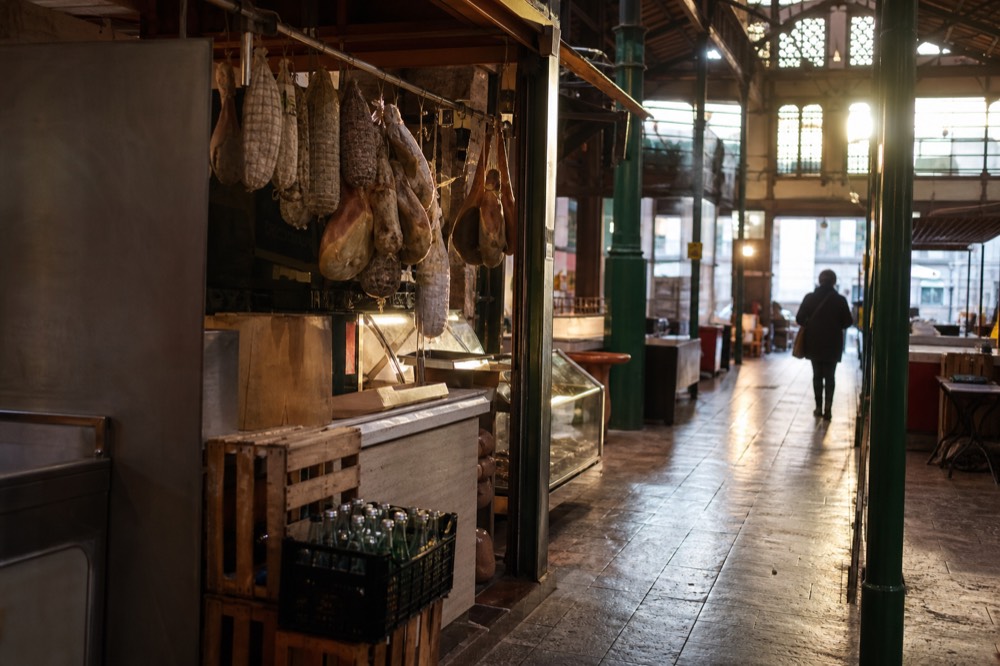
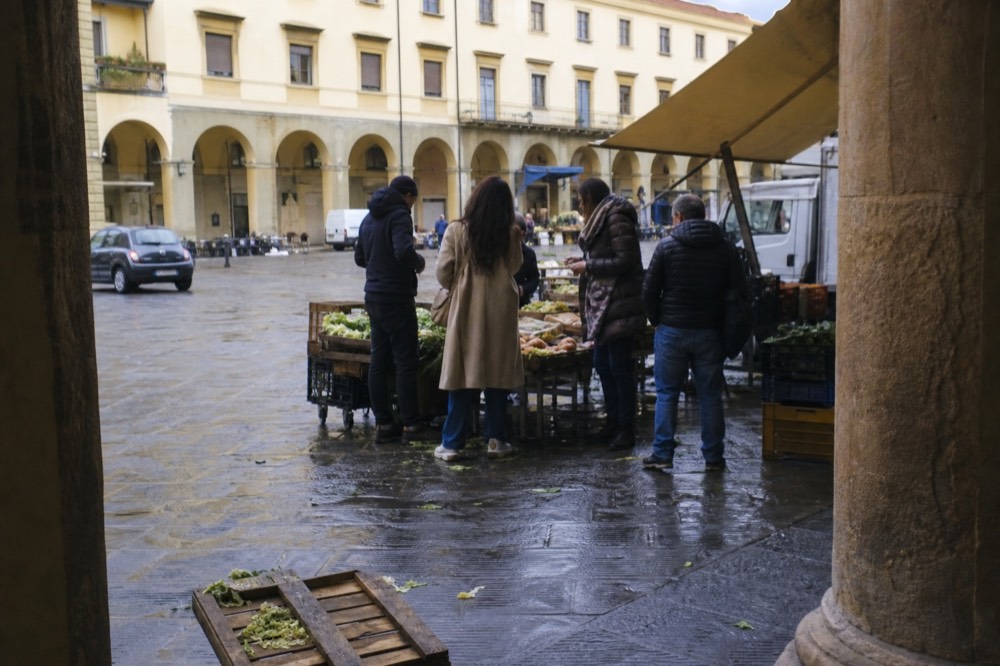
A great deal: Mercato Centrale was inaugurated in 1874 as a cast-iron structure by the architect of Milan's Galleria Vittorio Emanuele II, its ground floor still holds over one hundred businesses trading Monday to Friday 07:00-15:00 and Saturdays to 17:00, and its first floor has been a food hall since April 2014, open every day 09:00-23:00. Sant'Ambrogio, the city's oldest market, was built in 1873 to a design by Giuseppe Mengoni, runs Monday to Saturday 07:00-14:00, and served as the wholesale fruit and vegetable centre until the 1960s. The Comune's own historic markets page is the source for both histories.
The two markets split the city's food personality. Mercato Centrale is the visitor-facing one: 3,250 square metres upstairs, artisan botteghe along two aisles, a pizzeria and a restaurant, and seating you can take anywhere without booking, except at those two. Sant'Ambrogio is the one Florentines actually shop in, and its covered stalls reopened in December 2025 after roughly two years of restoration works costing about 1.9 million euro, according to La Nazione, with new canopies letting every stall operate under cover and the recovered historic stone pavement visible through transparent sections.
One confusion worth killing: the outdoor San Lorenzo market wrapped around Mercato Centrale sells clothing, leather goods and souvenirs, not food. Visitors routinely arrive expecting a produce market and find handbags. The food is inside the building, on the ground floor by day and the first floor until 23:00. For a full breakdown of the upstairs food hall and the tours built around it, see our Mercato Centrale food tours guide.
The markets also explain Florence's street-food fame. The city's single most famous single food business is arguably All'Antico Vinaio, the schiacciata shop on Via de' Neri whose queues are a Florence landmark in their own right. Il Sole 24 Ore reported that the chain turned over 80 million euro in 2025 and plans at least 20 new openings in 2026, and 055firenze.it reported its first 2026 location opening at Peretola airport on 9 April 2026. One food tour on the roster, at 2 hours the shortest listed, is built around exactly this: it includes five gastronomic stops plus wine tasting with All'Antico Vinaio included and a skip-the-line pass.
Which Food Tour Matches What Florence Is Famous For?
Match the tour to the thing you came for: the steak dinner tour serves the fiorentina itself over four hours, the 3.5-hour steak and Tuscan wine walk packs 14 tastings and 4 wines into a small group capped at 12, and the street-food walk covers schiacciata, lampredotto and market snacking in 2.5 hours from $49. The table below maps each famous thing to the tours that actually include it, using the inclusions printed on each live listing.
| What Florence is known for | Tour that serves it | From price | Duration |
|---|---|---|---|
| Bistecca alla fiorentina, everything included | Florence: Guided Food Tour with Fiorentina Steak and Wine | $124.00 | 4 hours |
| Florentine steak dinner, small group | Florence: Food Walking Tour with Local Steak and Tuscan Wine | $80.00 | 3.5 hours |
| Street food, schiacciata, wine on a budget | Florence: Street Food Tour with Wine & Local Guide | $49.00 | 2.5 hours |
| Market hall tastings and drinks | Florence Central Market Food & Wine Tour | $111.21 | 3 hours |
| Cantucci with Vin Santo | Florence Old City Street Food Tour | $51.00 | 2.5 hours |
| All'Antico Vinaio with skip the line | Florence Food Tour with Antico Vinaio | $69.80 | 2 hours |
The steak-and-wine walk deserves a specific mention because of its value shape: 14 food tastings, four wines and a sit-down dinner with Florentine steak, in a group capped at 12, from $80.00. It carries a 4.9 across 725 reviews, and the listing flags it as likely to sell out, so it is worth checking the live listing for your dates early rather than planning around it. If the budget version of the same idea appeals, the street-food walk at $49.00 is the cheapest way to get wine included on any walk in the city, and it carries the biggest review base in its band at 1,869 reviews.
Why Does Florence's Food Reputation Keep Growing?
Because the city's food economy has shifted toward exactly the formats visitors want: between 2015 and 2025 Florence lost 119 traditional bars, a 14.6 percent decline, while table-service restaurants rose by 145 units and takeaway outlets also increased, according to a Fipe-Confcommercio study adapted regionally by Confcommercio Toscana. Fewer stand-up coffee bars, more restaurants and takeaway counters is the structural change behind both the food-hall boom and the street-food tour boom. The same pattern shows up in the operator layer: Eating Europe's sunset food and wine tour in Oltrarno now carries a 5.0 across 5,911 reviews on its live listing, the largest review base of any Florence food tour you can book.
The TasteAtlas ranking mentioned earlier fits the same curve. So does the market investment: nearly 2 million euro spent restoring Sant'Ambrogio's covering, a first-floor concession at Mercato Centrale renewed until February 2035 according to La Nazione, and solar-shading works completed in August 2026 to make summer visits more comfortable. Cities do not spend that kind of money on markets unless the food economy is carrying weight.
There is a quieter angle too, and it is the one this site exists for. Florence's food fame is increasingly something you can book, in formats from a $45 highlights walk to a $259 market tour with a four-course pasta class you cook yourself. The famous things, the steak, the schiacciata, the cantucci, the market stalls, are all reachable on foot from the centre, and the guides who walk you between them are the difference between eating well by luck and eating well by design.
If you are still deciding which slice of the reputation to taste first, these three are the ones we would shortlist between them.
Florence is best known for Renaissance art and for a food identity built on protected Tuscan products, Chianti Classico wine, the bistecca alla fiorentina, two historic covered markets and a street-food culture centred on schiacciata and lampredotto, and the answers below cover each of those in the order visitors usually ask about them. The steak question is the one worth reading most carefully, because it is where the popular story and the legal reality diverge most sharply.
Common Questions About What Florence Is Best Known For
What is Florence, Italy best known for?
Renaissance art and architecture first, and on the plate: protected Tuscan products including Prosciutto Toscano DOP, Pecorino Toscano DOP, Finocchiona IGP, Cantucci Toscani IGP and Pane Toscano DOP, Chianti Classico wine, the bistecca alla fiorentina, and two historic covered markets, Mercato Centrale and Sant'Ambrogio.
Is bistecca alla fiorentina a protected product?
No. There is no DOP, IGP, STG or municipal denomination for the steak, and no legal minimum thickness or weight. The real designation in the story is Vitellone Bianco dell'Appennino Centrale IGP, which covers Chianina, Marchigiana and Romagnola cattle equally and whose production area includes the province of Firenze.
What food is actually protected in Tuscany?
Prosciutto Toscano DOP and Pecorino Toscano DOP since 1996, Lardo di Colonnata IGP since 2004, Cinta Senese DOP since 2012, Finocchiona IGP since 2015, and Cantucci Toscani IGP and Pane Toscano DOP since 2016, plus Chianti Classico wine and a separate Chianti Classico olive oil PDO.
Which market should I visit for food, San Lorenzo or Sant'Ambrogio?
Mercato Centrale in San Lorenzo is the food destination, with over one hundred ground-floor businesses and a first-floor food hall open every day 09:00-23:00. The outdoor stalls around it sell leather and souvenirs, not food. Sant'Ambrogio, Monday to Saturday 07:00-14:00, is the market Florentines shop in.
Do I need a tour to eat well in Florence?
No, but a tour reliably reaches the protected products, the best market stalls and a properly sourced steak without the trial and error. The tours we track run from $45.00 for a 2.5-hour street-food walk to $124.00 for a four-hour steak dinner with everything included, and 21 of the 22 carry free cancellation up to 24 hours before the start time.